 Add to Chrome
 Add to Firefox
 Add to Edge
TIGER: Traceable Inference with Graph-Based Evidence Routing for Mitigating Hallucinations in Multimodal Generation
May 29, 2026
We study fact-level repair for multimodal generation, where a fluent output may contain specific facts that are not supported by the input. Existing inference-time repair methods often generate feedback by jointly conditioning on the input and the current output. This design has two limitations: hallucinated claims in the output can bias the model's interpretation of the input, and free-form feedback cannot be ranked or scheduled at the fact level. We present TIGER, an inference-time framework that redesigns feedback for localized repair. TIGER independently extracts an observation graph from the input and a claim graph from the current output, then assigns each claim a graph-conditioned risk score based on support and conflict. The model repairs selected high-risk claims while keeping the backbone frozen. We provide a convergence analysis showing that the expected total risk decreases geometrically to an explicit asymptotic bound under mild assumptions. Experiments across four cross-modal paths, including image-to-text, image+text-to-text, audio-to-text, and video-to-text, show that TIGER reduces unsupported content while preserving task quality. The gains hold across multiple backbones, and a CrisisFACTS case study suggests that the same repair mechanism can improve grounding in multi-source settings.

LARK: Learnability-Grounded Trajectory Selection for Efficient Reasoning Distillation
May 28, 2026We study trajectory selection for reasoning distillation, where teacher-generated reasoning trajectories are selectively used as supervision for a student model. Existing methods rely on heuristics such as trajectory quality or model confidence, but they often overlook whether a trajectory is learnable by the student. In this paper, we present LARK, a learnability-grounded method for reasoning trajectory selection. LARK selects trajectories that the student can learn efficiently while preserving the generalization of the full training distribution. At the core of LARK is a learnability factor $ρ$, which characterizes the rate at which the student's training loss decreases. To estimate this rate efficiently and maintain generalization, we introduce a learnability proxy and a $χ^2$-regularized selection policy that balances learnability and distributional coverage, both with strong theoretical guarantees on their estimation error. Empirically, LARK consistently outperforms data selection baselines across multiple base models and reasoning tasks. Diagnostic analyses show that the LARK score predicts downstream training utility and that LARK-selected trajectories induce faster supervised fine-tuning loss reduction. Our code is available at https://github.com/Tianrun-Yu/LARK.
FRAME: Forensic Routing and Adaptive Multi-path Evidence Fusion for Image Manipulation Detection
May 12, 2026The proliferation of sophisticated image editing tools and generative artificial intelligence models has made verifying the authenticity of digital images increasingly challenging, with important implications for journalism, forensic analysis, and public trust. Although numerous forensic algorithms, ranging from handcrafted methods to deep learning-based detectors, have been developed for manipulation detection, individual methods often suffer from limited robustness, fragmented evidence, or weak generalization across manipulation types and image conditions. To address these limitations, we present \textbf{FRAME}, a method for \textbf{F}orensic \textbf{R}outing and \textbf{A}daptive \textbf{M}ulti-path \textbf{E}vidence fusion for image manipulation detection. FRAME organizes diverse forensic algorithms into a multi-path analysis space, adaptively selects informative forensic paths for each input image, and fuses complementary evidence to improve detection and localization performance. By moving beyond single-method analysis and fixed fusion strategies, FRAME provides a more robust and flexible approach to image forensic reasoning while preserving interpretable forensic cues from multiple evidence sources. Experimental results demonstrate the effectiveness of FRAME across diverse manipulation scenarios. Code is available at \href{https://github.com/kzhao5/FRAME}{https://github.com/kzhao5/FRAME}.
GraphIP-Bench: How Hard Is It to Steal a Graph Neural Network, and Can We Stop It?
May 12, 2026Graph neural networks (GNNs) deployed as cloud services can be \emph{stolen} through \emph{model-extraction attacks}, which train a surrogate from query responses to reproduce the target's behaviour, and a growing line of ownership defenses tries to prevent or trace such theft. The title of this paper asks two questions: \emph{how hard is it to steal a GNN?}, and \emph{can we stop it?} Prior work cannot answer either, because experiments use inconsistent datasets, threat models, and metrics. We introduce \emph{GraphIP-Bench}, a unified benchmark which evaluates both sides under a single black-box protocol. It integrates twelve extraction attacks, twelve defenses spanning watermarking, output-perturbation, and query-pattern-detection families, ten public graphs covering homophilic, heterophilic, and large-scale regimes, three GNN backbones, and three graph-learning tasks, and it reports fidelity, task utility, ownership verification, and computational cost on shared splits, queries, and budgets. We further add a joint attack-and-defense track which runs every attack on every defended target and measures watermark verification on the resulting surrogate, which exposes the protection that a defense retains after extraction. The empirical picture is short: stealing a GNN is easy at medium query budgets and most defenses do not change this; several watermarks verify reliably on the protected model but lose most of their verification signal on the extracted surrogate, which exposes a gap that single-model evaluations miss; and heterophilic graphs are systematically harder to steal, while a cross-architecture mismatch between target and surrogate reduces but does not prevent extraction. Code: \href{https://github.com/LabRAI/GraphIP-Bench}{LabRAI/GraphIP-Bench}.
FACTOR: Counterfactual Training-Free Test-Time Adaptation for Open-Vocabulary Object Detection
May 05, 2026Open-vocabulary object detection often fails under distribution shifts, as it can be misled by spurious correlations between non-causal visual attributes (e.g., brightness, texture) and object categories. Existing test-time adaptation (TTA) methods either depend on costly online optimization or perform global calibration, overlooking the attribute-specific nature of these failures. To address this, we propose FACTOR (counterFACtual training-free Test-time adaptation for Open-vocabulaRy object detection), a lightweight framework grounded in counterfactual reasoning. By perturbing test images along non-causal attributes and comparing region-level predictions between original and counterfactual views, FACTOR quantifies attribute sensitivity, semantic relevance, and prediction variation to selectively suppress attribute-dependent predictions-without parameter updates. Experiments on PASCAL-C, COCO-C, and FoggyCityscapes show that FACTOR consistently outperforms prior TTA methods, demonstrating that explicit counterfactual reasoning effectively improves robustness under distribution shifts.
Provable and Practical In-Context Policy Optimization for Self-Improvement
Mar 02, 2026We study test-time scaling, where a model improves its answer through multi-round self-reflection at inference. We introduce In-Context Policy Optimization (ICPO), in which an agent optimizes its response in context using self-assessed or externally observed rewards without modifying its parameters. To explain this ICPO process, we theoretically show that with sufficient pretraining under a novel Fisher-weighted logit-matching objective, a single-layer linear self-attention model can provably imitate policy-optimization algorithm for linear bandits. Building on this theory, we propose Minimum-Entropy ICPO (ME-ICPO), a practical algorithm that iteratively uses its response and self-assessed reward to refine its response in-context at inference time. By selecting the responses and their rewards with minimum entropy, ME-ICPO ensures the robustness of the self-assessed rewards via majority voting. Across standard mathematical reasoning tasks, ME-ICPO attains competitive, top-tier performance while keeping inference costs affordable compared with other inference-time algorithms. Overall, ICPO provides a principled understanding of self-reflection in LLMs and yields practical benefits for test-time scaling for mathematical reasoning.
Intellectual Property in Graph-Based Machine Learning as a Service: Attacks and Defenses
Aug 27, 2025Graph-structured data, which captures non-Euclidean relationships and interactions between entities, is growing in scale and complexity. As a result, training state-of-the-art graph machine learning (GML) models have become increasingly resource-intensive, turning these models and data into invaluable Intellectual Property (IP). To address the resource-intensive nature of model training, graph-based Machine-Learning-as-a-Service (GMLaaS) has emerged as an efficient solution by leveraging third-party cloud services for model development and management. However, deploying such models in GMLaaS also exposes them to potential threats from attackers. Specifically, while the APIs within a GMLaaS system provide interfaces for users to query the model and receive outputs, they also allow attackers to exploit and steal model functionalities or sensitive training data, posing severe threats to the safety of these GML models and the underlying graph data. To address these challenges, this survey systematically introduces the first taxonomy of threats and defenses at the level of both GML model and graph-structured data. Such a tailored taxonomy facilitates an in-depth understanding of GML IP protection. Furthermore, we present a systematic evaluation framework to assess the effectiveness of IP protection methods, introduce a curated set of benchmark datasets across various domains, and discuss their application scopes and future challenges. Finally, we establish an open-sourced versatile library named PyGIP, which evaluates various attack and defense techniques in GMLaaS scenarios and facilitates the implementation of existing benchmark methods. The library resource can be accessed at: https://labrai.github.io/PyGIP. We believe this survey will play a fundamental role in intellectual property protection for GML and provide practical recipes for the GML community.
A Systematic Survey of Model Extraction Attacks and Defenses: State-of-the-Art and Perspectives
Aug 20, 2025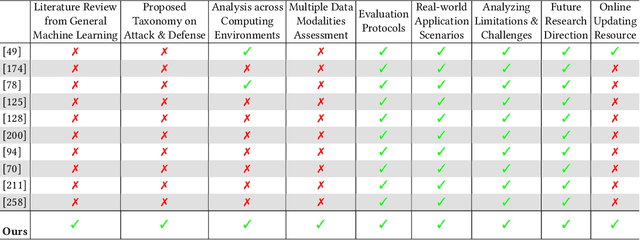
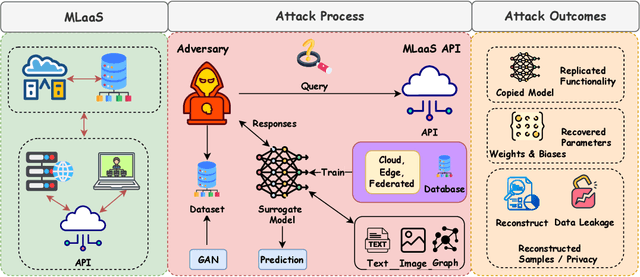
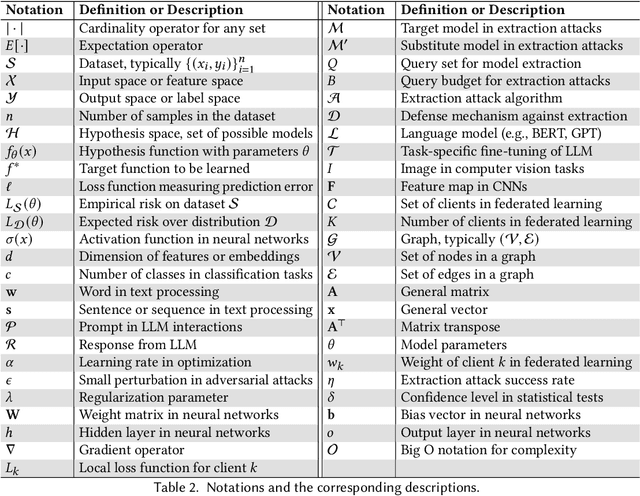
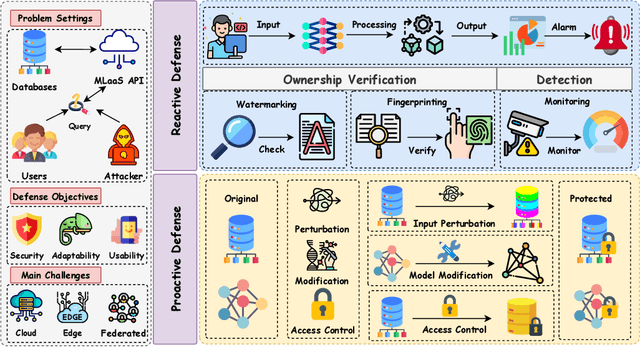
Machine learning (ML) models have significantly grown in complexity and utility, driving advances across multiple domains. However, substantial computational resources and specialized expertise have historically restricted their wide adoption. Machine-Learning-as-a-Service (MLaaS) platforms have addressed these barriers by providing scalable, convenient, and affordable access to sophisticated ML models through user-friendly APIs. While this accessibility promotes widespread use of advanced ML capabilities, it also introduces vulnerabilities exploited through Model Extraction Attacks (MEAs). Recent studies have demonstrated that adversaries can systematically replicate a target model's functionality by interacting with publicly exposed interfaces, posing threats to intellectual property, privacy, and system security. In this paper, we offer a comprehensive survey of MEAs and corresponding defense strategies. We propose a novel taxonomy that classifies MEAs according to attack mechanisms, defense approaches, and computing environments. Our analysis covers various attack techniques, evaluates their effectiveness, and highlights challenges faced by existing defenses, particularly the critical trade-off between preserving model utility and ensuring security. We further assess MEAs within different computing paradigms and discuss their technical, ethical, legal, and societal implications, along with promising directions for future research. This systematic survey aims to serve as a valuable reference for researchers, practitioners, and policymakers engaged in AI security and privacy. Additionally, we maintain an online repository continuously updated with related literature at https://github.com/kzhao5/ModelExtractionPapers.
A Survey of Model Extraction Attacks and Defenses in Distributed Computing Environments
Feb 22, 2025Model Extraction Attacks (MEAs) threaten modern machine learning systems by enabling adversaries to steal models, exposing intellectual property and training data. With the increasing deployment of machine learning models in distributed computing environments, including cloud, edge, and federated learning settings, each paradigm introduces distinct vulnerabilities and challenges. Without a unified perspective on MEAs across these distributed environments, organizations risk fragmented defenses, inadequate risk assessments, and substantial economic and privacy losses. This survey is motivated by the urgent need to understand how the unique characteristics of cloud, edge, and federated deployments shape attack vectors and defense requirements. We systematically examine the evolution of attack methodologies and defense mechanisms across these environments, demonstrating how environmental factors influence security strategies in critical sectors such as autonomous vehicles, healthcare, and financial services. By synthesizing recent advances in MEAs research and discussing the limitations of current evaluation practices, this survey provides essential insights for developing robust and adaptive defense strategies. Our comprehensive approach highlights the importance of integrating protective measures across the entire distributed computing landscape to ensure the secure deployment of machine learning models.